


By Dr Ivona Igerc, GDC-registered doctor and aesthetic practitioner, founder of Dr Ivy London. Published: August 2026.
The short answer
Exosome serum goes on clean skin, after cleansing and before moisturiser. Dr Ivy's label says morning and evening; other serums vary, so follow the label on the one you own. Use a few drops, press them gently onto the face and neck rather than rubbing, and let the serum absorb before the next layer. Follow with a moisturiser, and with sunscreen in the morning when the UV index is 3 or higher. The American Academy of Dermatology gives the same broad order for any routine: cleanse, then treatment, then moisturiser and/or sunscreen. Exosome serum is the treatment step. Two targeted PubMed searches for studies comparing application orders returned no records, so treat layering advice, including this, as reasoned practice rather than established fact.
Where exosome serum goes in your routine
Exosome serum is a treatment step. It goes on after cleansing and before moisturiser, so it meets the skin directly rather than through another product. The American Academy of Dermatology publishes a four-step order for any skincare routine, and the treatment step is where a serum sits.
Most confusion about exosome serums comes from treating them as a new category that needs new rules. They do not need new rules. An exosome serum is a leave-on treatment, and it sits where leave-on treatments sit.
The American Academy of Dermatology, the professional body for dermatologists in the United States, publishes a plain order for any skincare routine and states that "the sequence in which you apply your skin care products affects how well the products work".1 Its four steps are:
- Wash your face, using a gentle cleanser, and pat dry.
- Apply medication or treatment, right after cleansing.
- Apply moisturiser and/or sunscreen. The AAD groups these two into one step.
- Apply make-up, if you wear it.
Two things that guidance does not do, and it matters that they are said plainly. It is general skincare ordering, written by a United States body, and it does not mention exosomes at all. And because moisturiser and sunscreen share one step, and the AAD writes "and/or", it does not tell you which of the two goes on first, or that you need both.
What it does give you is the principle: the treatment step goes directly onto clean skin, before anything that would sit between the treatment and the skin. An exosome serum is a treatment. So the working order is cleanse, exosome serum, moisturiser, then sunscreen in the morning when the UV index is 3 or higher.
Putting sunscreen after moisturiser rather than before is this guide's suggestion, not the AAD's. The AAD leaves that open.
Dr Ivy's own directions for its serum describe a three-step sequence: cleanse and pat dry, press a few drops onto the face and neck and allow to absorb fully, then follow with the cream. Those are the brand's instructions for its own product. That is a different thing from evidence that this order is optimal, and it is worth keeping the two apart.
If you want the background on the ingredient itself rather than the routine, start with what exosome skincare actually is.
Morning or night, and how often to use it
Dr Ivy's serum is labelled for use morning and evening. Other exosome serums differ, so the label on the product you own is the instruction that counts. The morning step worth getting right is sunscreen, which the NHS advises at SPF 30 or higher with at least four-star UVA protection when the UV index is 3 or above.
Dr Ivy's serum is labelled AM and PM, and its product page lists usage as morning and evening. That is the sourced instruction for that product, and it is the only one this guide can give you. For any other exosome serum, follow that product's label. Formulations differ, and a guide that tells you what "most" serums say is guessing on your behalf.
What changes between morning and evening is not the serum. It is what goes on top.
In the morning, the layer worth getting right is sunscreen. NHS guidance is to use at least factor 30, with at least four-star UVA protection, and it notes that most people do not apply enough.2 On when to bother, the NHS points to the UV index: if it is 3 or higher, consider protecting your skin. It also advises spending time in the shade when the sun is strongest, which in the UK is between 11am and 3pm from March to October.2 No serum in any category substitutes for that, and this one is not a sun-protection product.
In the evening, there is nothing to layer over the moisturiser, so the routine is shorter: cleanse, serum, moisturiser.
On frequency: use it as often as the label directs, and no more often than that.
How much to use, and how to apply it
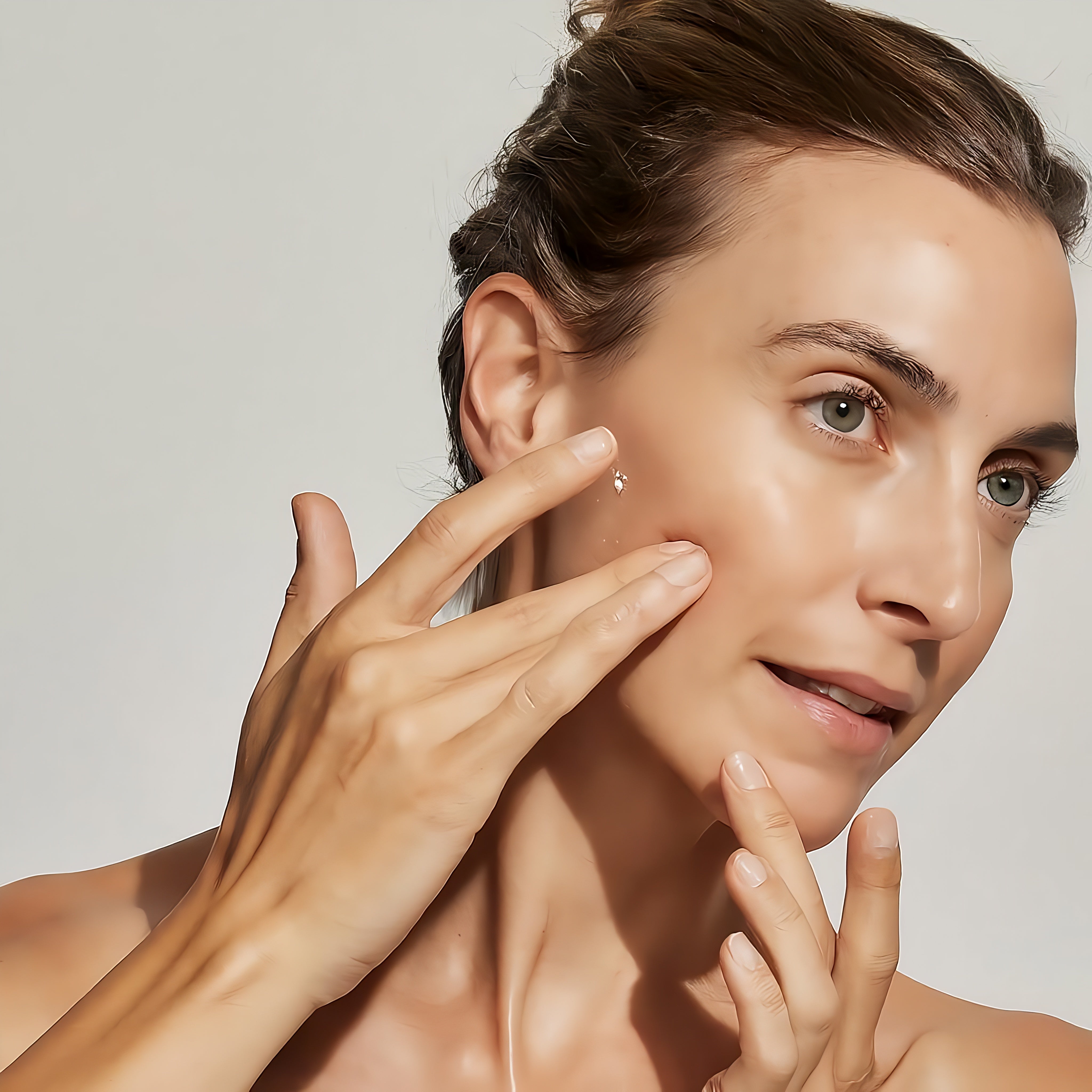
A few drops covers the face and neck. Dr Ivy's directions are to apply a few drops to your palms and press gently onto the face and neck, allowing the serum to absorb fully before the next step.
Three practical points, taken from the brand's own directions rather than invented around them.
- A few drops, applied to your palms. Dr Ivy's instruction is to apply a few drops to the palms and press them gently onto the face and neck. A few drops covers both; more than that mostly ends up on your hands.
- Press rather than rub. "Press gently" is the brand's own wording. This guide has no evidence that pressing gets more product into the skin than rubbing does, so treat it as the manufacturer's instruction rather than as a technique with a proven advantage.
- Include the neck, and let it absorb. The directions name the face and neck together, and say to allow the serum to absorb fully before the next step. In practice that is a short pause, not a timed wait. The neck is often the area that gets left out.
One honest note on damp versus dry skin, because Dr Ivy's own pages do not agree with each other. The product page's step-by-step says to cleanse, rinse and pat the skin dry. Its FAQ says to apply the serum to damp skin. Both are the brand's, and no source here settles which is better, so the practical answer is that this is not a detail worth worrying about. If you prefer one, use it consistently.
The next step, in the brand's own sequence, is the cream. Dr Ivy's directions say to follow the serum with it.
Dr Ivy states that its Regenerative Exosome Serum contains 17.5 million exosomes per dose. That is the brand's own figure, supplied by the brand rather than established by an independent test, and it describes what is in the dose. It is not a measurement of how much of it reaches the skin.
Layering exosome serum with other actives
The sources collected for this guide do not establish how an exosome serum interacts with other actives, in either direction. Formulations differ. The reliable instruction is to follow the label on each product you are using, and to introduce one new active at a time.
This is where most routine guides become confident and stop being accurate. So, plainly: the sources collected for this guide do not establish that an exosome serum is compatible, or incompatible, with any other active. This guide therefore cannot give you a clean yes on any of the combinations below.
Searches of PubMed on 18 August 2026 for exosomes alongside each of the five ingredients below did return records, so "no research exists" would be wrong. On screening, what they describe is different from what a reader is asking about: products that combine the ingredients in a single formulation (for example a study of retinal encapsulated inside a biomimetic exosome, and one of plant compounds carried in a milk-exosome emulsion), and clinic procedures such as microneedling. None of them tests layering two separate consumer products, which is the actual question.
The middle column below is this guide's cautious suggestion. It is not a documented convention and it is not a finding.
| Layering with | This guide's cautious suggestion | What the searches found |
|---|---|---|
| Vitamin C | Apply the thinner product first, then the other, then moisturiser | 4 records, none testing two layered products |
| Niacinamide | Thinner product first | 20 records, none on topical layering; the set is dominated by unrelated oncology research |
| Exfoliating acids (AHA, BHA) | Consider separating them, using acids at a different time or on different days | 6 records, all concerning wounds or clinic procedures, none testing consumer layering |
| Retinol | Consider alternating nights while adjusting to a retinol rather than applying both in one evening. See how exosomes and retinol compare | 7 records. The closest is a study of retinal encapsulated inside an exosome, which is one product, not two layered |
| Peptides | Check the ingredient list: peptides may already be in the formula you own | 44 records. Screening found delivery systems, reviews and clinical therapy; none tested consumer layering |
Three rules carry more weight than any row in that table, because none of them depends on evidence this article does not have.
Follow the label on each product. If two labels give incompatible directions, ask the manufacturers for product-specific advice before combining them. They are the ones who know their formulations.
Introduce one new product at a time. If you start three products in one week and your skin reacts, you have no way of knowing which one did it.
If something stings, stop using it. Skincare should not hurt. Persistent stinging, burning or a rash means stopping the product that caused it, not persevering. If you cannot tell which product caused it, stop the new one first, and if the reaction does not settle, speak to a GP or a pharmacist.
What is evidence, and what is convention
Two targeted PubMed searches for application-order studies returned no records, and a broader 386-record set was not screened. The order set out above is therefore reasoned convention. The research that does exist on plant-derived vesicles in skin is largely laboratory and animal work, and reviewers note the field lacks standardised methods.
This is the section most brands leave out, so it is worth being direct.
Two exact-phrase searches of PubMed for application-order studies on topical exosome products, run on 18 August 2026, returned no records. A third, broader search returned 386 records, which were not screened one by one; that set is dominated by molecular-biology uses of the word "sequence" rather than application sequence. So the honest statement is narrow: those searches found nothing, not that nothing exists. The order recommended at the top of this article rests on a general principle about leave-on treatments, and on the manufacturer's directions, not on a study of application order.
The underlying science is at an early stage too. In a 2025 review of plant-derived exosome-like nanovesicles published in the Journal of Nanobiotechnology, Hui Liu and colleagues write that "interspecies variability in morphology, size, and purity, coupled with the absence of standardized protocols, poses significant challenges for clinical translation".3 The evidence in that review on how these vesicles move through skin comes from laboratory and animal models: broccoli-derived vesicles tested on porcine skin, cucumber-derived vesicles used to carry other compounds, diffusion assays on mouse skin.3 That is real research, and it is preclinical research into therapeutic potential in skin disease. It is not evidence about how a finished cosmetic serum behaves on a human face, and it should not be read that way.
None of this is a reason to skip the routine. A sensible order costs nothing. What it does not entitle anyone, this brand included, to say is that a particular sequence has been shown to work better than another.
For the fuller picture on the ingredient, read what the evidence does and does not show, where the exosomes in a serum come from, and the UK safety picture.
Four mistakes that waste an exosome serum
The common ones are using too many actives at once, applying a treatment to a face that is not clean, skipping sunscreen when the UV index is 3 or higher, and changing products before a routine has had time to show anything.
- Stacking too much. The American Academy of Dermatology puts it plainly: "Using too many products may irritate the skin," and it singles out routines that stack more than one anti-ageing product.1 Cleanser, serum, moisturiser, and sunscreen when the UV index is 3 or higher, is a full daytime routine on its own.
- Applying it to a face that is not clean. A treatment step applied over the day's sunscreen and make-up is applied to sunscreen and make-up.
- Skipping sunscreen when the UV is up. An anti-ageing routine that leaves out sun protection on the days it matters is working against itself. The NHS threshold, and its SPF and UVA advice, are above.
- Changing course too early. A new purchase is not evidence, and neither is the first impression of one. Switching products before you have used either of them properly leaves you knowing nothing about both.
How long before you see anything
No source in this guide supports a specific interval for judging an exosome serum. Use it consistently as labelled, keep a record you can actually compare against, and be sceptical of any timeline, including a brand's own, that is not backed by a published trial on that product.
Dr Ivy's product page tells customers when they typically report noticing something. No controlled trial is cited alongside those figures, and they should be read with that in mind.
This guide is not going to replace one unsupported number with another, so it will not give you a week count. What it can offer is procedure. Use the product consistently, as its label says. Take a photograph in the same light on day one, so that you are comparing your skin against a record rather than against a memory. Judge the routine rather than the week you have had. And a routine that has changed nothing, after you have genuinely stuck to it, has told you something worth knowing.
Frequently asked questions
How often should you use an exosome serum? As often as the label on your product directs. Dr Ivy's serum is labelled for morning and evening use. Other exosome serums differ, so check yours rather than applying a general rule. Do not use it more often than the label directs, and use it consistently rather than in bursts.
Should you apply exosome serum in the morning or at night? Whichever the label specifies, and both if it says both, as Dr Ivy's does. The practical difference is what goes on top: in the morning, a moisturiser and then sunscreen when the UV index is 3 or higher; in the evening, a moisturiser and nothing else.
What should you put on after an exosome serum? A moisturiser, once the serum has absorbed. Dr Ivy's directions say to follow its serum with its cream. In the morning, sunscreen goes on after the moisturiser when the UV index is 3 or higher, at SPF 30 or higher with at least four-star UVA protection, per NHS guidance.
Can you use an exosome serum with retinol? The sources collected for this guide do not establish that the two are compatible or incompatible, so this guide cannot give you a clean yes. Follow both product labels. A cautious approach is to alternate nights while adjusting to a retinol rather than applying both in one evening. Searches found studies of retinal built into an exosome formulation, which is a single product rather than two layered ones.
Can you use an exosome serum with vitamin C or niacinamide? The same answer applies: the sources collected here do not establish compatibility either way, and formulations differ, so follow both labels. A cautious approach is to apply the thinner product first and let it absorb. If a product stings or your skin reacts, stop using that product rather than continuing.
Can you apply exosome serum to the neck? Yes, if your product's directions say so. Dr Ivy's name the face and neck together, and a few drops covers both. The neck is often left out of a routine, so including it closes an obvious gap.
Can you use an exosome serum alongside an at-home skincare device? Follow the instructions supplied with your device. Device manufacturers set their own guidance on what may be applied to the skin before or after use, and that guidance is specific to the device rather than to the serum. This guide does not cover device routines.
About the author
Dr Ivona Igerc, GDC-registered doctor and aesthetic practitioner, is the founder of Dr Ivy London. Read more about Dr Ivy.
The routine, not the bottle
This guide sets out the order Dr Ivy gives for its own serum, placed inside the general routine order the American Academy of Dermatology publishes. If you use a different exosome serum, its label is your instruction. The one part above that is not brand-specific is the AAD's framework: cleanse, treatment, then moisturiser and/or sunscreen.
Dr Ivy makes one of the serums this routine was written around. If you are still deciding which to buy rather than how to use the one you own, read how to choose one in the first place first.
-
American Academy of Dermatology, "Should I apply my skin care products in a certain order?" https://www.aad.org/public/everyday-care/skin-care-basics/care/apply-skin-care-certain-order (accessed 18 August 2026). General skincare ordering guidance from a United States body, not exosome-specific. Its third step groups moisturiser and sunscreen together, so it does not order those two relative to each other. ↩↩
-
NHS, "Sunscreen and sun safety". https://www.nhs.uk/live-well/seasonal-health/sunscreen-and-sun-safety/ (accessed 18 August 2026). ↩↩
-
Liu H, Dong T, Dong C, Yang F, Zhou Q, Guan C, Wang W. "Plant-derived exosome-like nanovesicles: a novel therapeutic perspective for skin diseases." Journal of Nanobiotechnology, published 10 October 2025. DOI 10.1186/s12951-025-03715-1. https://pmc.ncbi.nlm.nih.gov/articles/PMC12514849/ (accessed 18 August 2026). A review of preclinical research into therapeutic potential in skin disease; the penetration findings cited are from laboratory and animal models. ↩↩
Share:
Are Sardines Good for Your Skin? A Doctor's Guide to Marine Nutrition
Could Low Ferritin Be Behind Your Skin’s Lost Glow?