

Exosome skincare brings regenerative science into your daily routine. It uses tiny particles called vesicles, often sourced from plants, in serums and creams. Researchers are studying how these particles interact with skin, with human studies reporting improvements in hydration, elasticity and wrinkle appearance for the formulations tested.
If you are noticing fine lines, uneven texture or a loss of firmness, there is good reason to take a closer look. Understanding how exosome skincare works starts with something remarkable about cells: their ability to communicate.
What are exosomes?
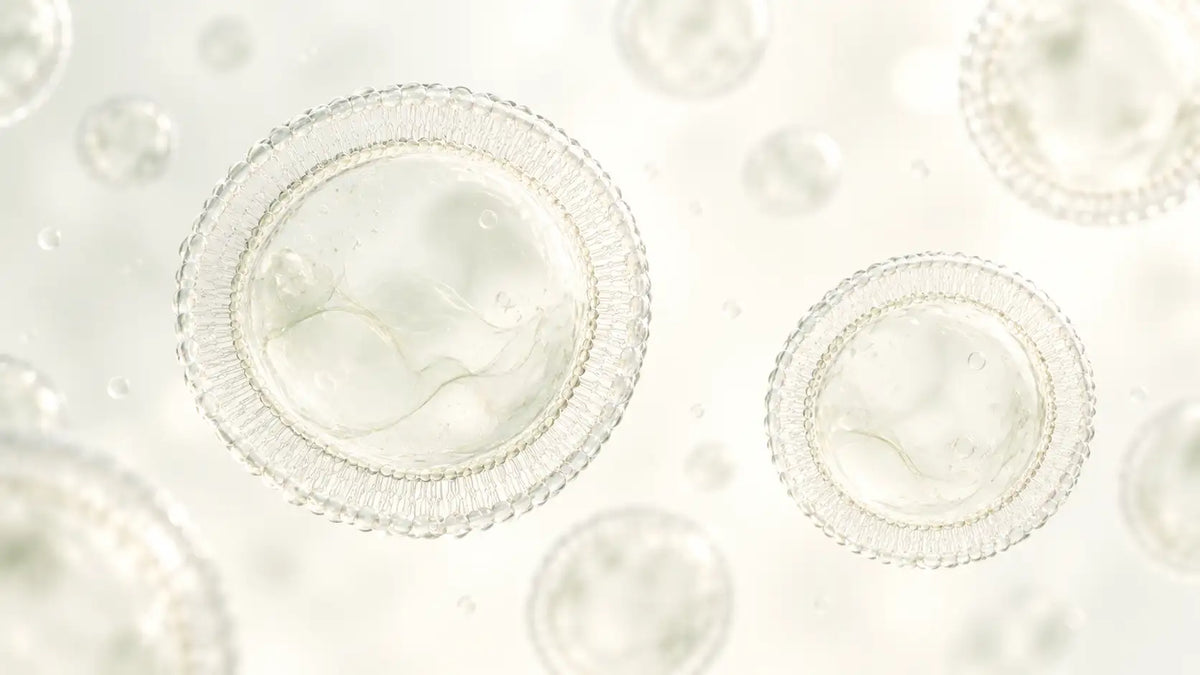
Cells constantly exchange information. One way they do this is by releasing microscopic packages that carry proteins, RNA and other biological material. These packages, enclosed in a fatty membrane, are known as extracellular vesicles. Exosomes are a particular type.
Their role in communication between cells has made them an important subject in regenerative research. Scientists are investigating how they influence processes involved in skin repair, collagen maintenance and responses to environmental stress.
In skincare, “exosomes” is often used as a broader description. Researchers generally use “extracellular vesicles” unless the particles’ precise origin within the cell has been established, as explained in the International Society for Extracellular Vesicles’ guidelines.
Where do skincare exosomes come from?
Vesicles can come from different sources, including plants. Their contents and properties depend on where they come from and how they are prepared, which makes the source an important part of any formulation.
Dr Ivy London uses vesicles from Centella asiatica. These are tiny particles obtained from the plant, rather than living plant stem cells or human cells.
They are combined with other carefully chosen ingredients, including peptides in the serum and glycerin in the face cream. Each ingredient has a role, and the complete formula shapes how the product feels and performs on your skin.
Why are plant-derived vesicles exciting for skincare?
The interest goes beyond moisture. Researchers are exploring how plant-derived vesicles interact with skin cells and influence processes associated with skin ageing.
In a 2025 study of Centella asiatica vesicles, laboratory experiments found antioxidant activity and effects on pigmentation-related and inflammatory responses. The researchers also examined a vesicle-containing gel in mice with UV-induced skin damage.
This work explores questions that matter to skincare: how skin responds to stress, how its supporting structures are maintained and how changes in pigmentation develop. It is this connection with skin biology that places vesicles within the wider field of regenerative science.
What benefits have human studies found?
Research has moved beyond the laboratory to examine how vesicle-containing skincare performs on people’s skin.
In a 28-day pilot study published in 2025, twenty people applied a serum containing Centella asiatica vesicles twice daily. Researchers recorded improvements in hydration, elasticity, pigmentation, wrinkle scores and redness. A further ten people used a comparison formula without the vesicles.
Hydration and elasticity
The study recorded increased skin moisture and improvements in measured elasticity, the skin’s ability to recover after stretching. These are useful measures when investigating skincare for dryness and changes in firmness.
Wrinkle appearance
Image-based assessments also recorded improved wrinkle scores. This gives researchers a way to track changes in wrinkle appearance over time, alongside measurements of skin moisture and elasticity.
Tone and redness
Researchers measured reductions in melanin content and improvements in redness scores in the tested formulation. These findings add to the interest in plant-derived vesicles for skincare concerned with an uneven-looking complexion.
These are findings for the serum studied. When choosing your own skincare, look for evidence relevant to its particular ingredients and formulation.
What should you look for in exosome skincare?
Start with what you would like to improve. Fine lines, dryness and uneven tone can lead you towards different formulations, even when they share the same headline ingredient.
A clearly identified vesicle source is a useful first step. Then look at the full ingredient list, the product’s purpose and its application instructions. A serum and a cleanser have different jobs, and supporting ingredients deserve as much attention as the ingredient on the front of the bottle.
It is also worth looking past particle counts. A number tells you little about a product’s performance without information about how the particles were measured, prepared and incorporated into the formula.
The most helpful product information explains what is in the formula, why it is there and what evidence supports the benefits described.
How to use exosome skincare
There is no need for an elaborate routine. Dr Ivy London’s collection follows a familiar sequence: cleanse, apply serum, then follow with face cream.
- Cleanse. Use the Regenerative Exosome Cleanser according to its directions, then rinse and pat dry.
- Apply serum. Press a few drops of the Regenerative Exosome Serum gently onto your face and neck. Allow it to absorb before applying your cream. The serum is labelled for morning and evening use.
- Follow with cream. Massage a small amount of the Regenerative Exosome Face Cream into your face and neck.
Keep sun protection in your daytime routine. The NHS recommends sunscreen with at least SPF 30 and four-star UVA protection, alongside shade and protective clothing. Exosome skincare does not replace these essentials.
Introduce new products one at a time so you can see how your skin responds. If you use an at-home device, follow its instructions for skincare application. After a professional treatment, follow your practitioner’s advice.
Exosome skincare at Dr Ivy London
Dr Ivy London was founded by Dr Ivona Igerc, an aesthetic practitioner with more than 25 years’ experience. The collection brings her interest in regenerative science to daily skincare, with plant-derived vesicles at the heart of its cleanser, serum and face cream.
From Harley Street to your home, the approach is simple: thoughtful formulations, clear guidance and a routine that fits into everyday life.
Share:
What Is a Liquid Facelift? Dr Ivy on Natural-Looking Results